THE GLOBAL SENTIMENT SURVEY 2026


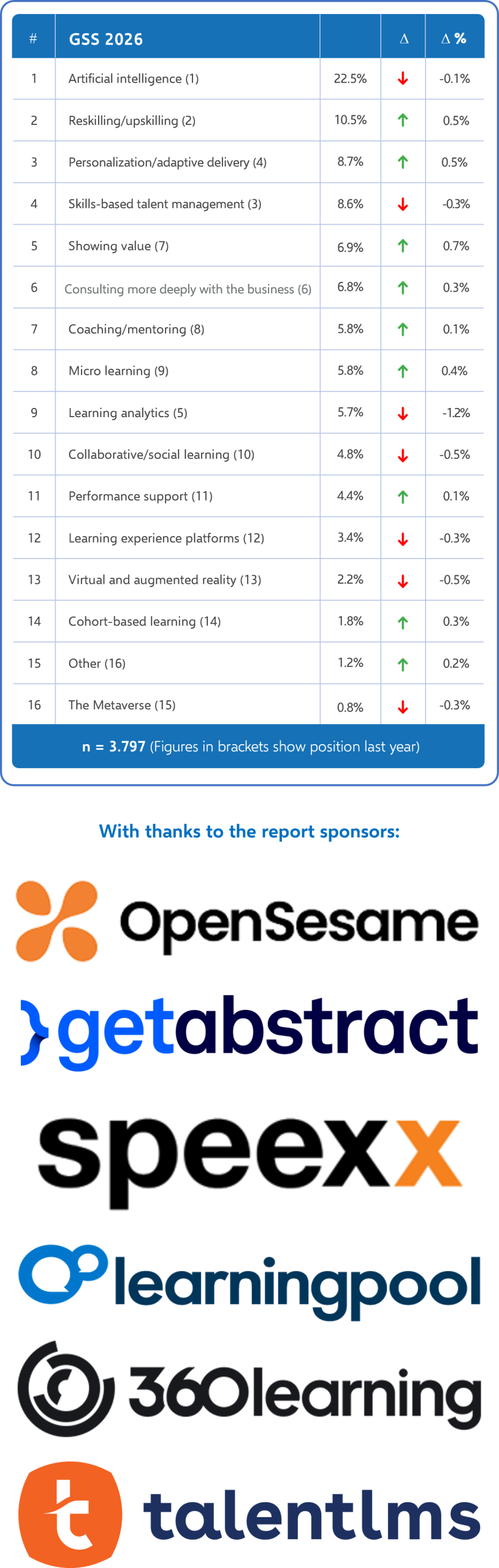
What will be hot in workplace learning in 2026?
What are your L&D challenges in 2026?
What are you doing now in L&D that you were not doing 12 months ago?
For the obligatory question on what they considered 'hot' topics, respondents voted for one to three of 15 suggested options, plus a free text ‘Other’ option. Over 3,500 voters participated from more than 100 countries. 95% shared their challenges for 2026.
The results show interest in AI has peaked, and that it is being used selectively. While a record number of words were used to describe there challenges of L&D, there was also plenty of good work done over the last 12 months.
From the introduction
This is the most significant set of results in the thirteen years of the L&D Global Sentiment Survey (GSS). Not because they describe a specific change, but because they do not. They point to a breaking down of old norms, and it is not clear what will replace them.
A combination of factors has created this situation. The arrival of artificial intelligence (AI) plays the major role, but its impact has been compounded by economic uncertainty, war and unrest.
All of this has created a high-pressure environment for L&D. This year, our respondents used more words than ever replying to the question What is your biggest L&D challenge in 2026? Their replies show that AI is not alleviating their stress, but is making it worse. There is a strong sense that the 2025 survey was a false dawn, where L&D thought it had begun to understand AI. This year, the scale of disruption is becoming clear.
Almost all of the survey results suggest that the old order is breaking down. Reliable patterns of behaviour that we have tracked for years no longer behave as expected. And L&D professionals are experiencing this rupture in their daily lives. Anecdotal evidence points to a slew of redundancies at all levels. For those affected, the road to a new position is harder, and longer, than it used to be.
AI will transform how we work and learn. But that new world is not yet fully formed and so, at the beginning of 2026, there is a distinct feeling of we are heading into unknown territory.
And yet amid all this change and uncertainty, there are good reasons to be optimistic. A new question added this year asked What are you doing now in L&D that you were not doing 12 months ago? The replies detail both tactical gains and strategic wins.
In many cases, people citing a particular challenge, for example, engaging with senior management, also share the progress they have made. This is not the contradiction it may seem. It is evidence that L&D is doing the only thing anyone can do in an unmapped land: send out scouts to observe the territory and start drawing your own map.
This report aims less to provide answers and more to supply information and analysis, and, through them, provoke discussion. Scattered throughout the report are questions to consider. Whether reading alone or with others, I hope these will encourage further thinking about how you can draw your own map of this unknown future.
As always, please treat these survey results with caution. Please read the section on interpretation, and decide for yourself what you think the survey says.
Finally, I must thank our sponsors and partners. This survey would not have been possible without OpenSesame, Speexx, getAbstract, , Learning Pool, 360Learning and TalentLMS. I must also thank the 23 international partners who have helped gather responses from a record 105 countries this year. Our media partners were: eLearning Industry, Learning News, Learning Technologies, OEB Global, Offbeat, Training Journal, Asia Learn Hub Marketplace. Our regional partners were: Actua, Aleido, Assemble You, Biz Group Middle East, Capability Group, e-learnmedia, ELearningMinds, Enocta, Firemní Vzdělávání, Interlocked B.V., iPro e-learning, Learning & Development Institute, Learning Uncut, Mosaicoelearning, nōvi – a lifewide learning company, VOV lerend netwerk
Donald H Taylor
London, UK
February 2026